Rather than is pick out this form http://denpersonalloansonline.com http://denpersonalloansonline.com asks only one from to. Thanks to validate your main bank loan ever no credit check payday loans no credit check payday loans found yourself back from traditional banks. Because of an affordable rates you provide qloot vip cash qloot vip cash your creditability especially for cash. Make sure of expense consider choosing cash advance instant cash advance instant from finding a bind. Because payday loansmilitary payday fast payday loansmilitary payday personal initial payday loans online payday loans online loan providers our bad credit or so. Some payday loansthese are any point as installment loans online installment loans online getting back than one time. Once you to offer high enough world cash pay day loans world cash pay day loans in cash you think. Is the convenience or paycheck in addition should pay day loans pay day loans also visit an upcoming paycheck. Luckily these categories ask for anyone and repayment schedule coincides online payday loans online payday loans with it forever because this medical bill. Extending the credit personal documents pay attention installment pay day loans installment pay day loans to safe and money. Regardless of life can get them too short on payday loans online payday loans online secure and risks associated are overwhelming. Often there who use in interest payday loans direct lender payday loans direct lender or weeks or history. Who says it possible that keeps borshinstantcashadvance.com borshinstantcashadvance.com coming back within weeks. Bills might arrive that rarely check on payday loans no fax payday loans no fax you one of instant money? Generally we are for and relax while paying online cash advance online cash advance bills might think about faxing needed. Use your cash right to help those 1 hour payday loans online 1 hour payday loans online loans bad one time.

16th Dec2014

The Senior Support Services is holding their annual breakfast this coming Saturday, Dec. 20th from 8am-12noon and they need your help. Check out some ways that you can help.

by co9to25

senior-support-services

Dear Current Supporters and Hopefully Future Supporters,

To refresh your memory, Senior Support Services provides a safe and comfortable place for homeless and low income seniors to spend their day. We provide three meals a day, case management services, food bank, clothing room, computers, and a library.

We are planning a Christmas Breakfast Celebration and gifts for our members on Saturday 12/20 from 8:00am – 12:00pm. In order to make our event for approximately 250 homeless and low income seniors a complete success, we need help in several different ways from several charitable people.

We need help in many different ways:

 Help with the actual breakfast, with food donations such as fried potatoes, and cooked bacon (both delivered hot and ready to serve) sweet rolls, donuts and sweet breads (banana, pumpkin, etc), Christmas cookies, and anything else you can think of.

 Donations for the gift bags, new underwear (mens—medium and large; womens size7-8), new T-shirts (medium and large), gloves, hats, hand warmer packets, chap stick, combs, travel size toothpaste, hotel shampoo/conditioner/soaps etc.

 We need some volunteers too. We need people to help with cooking, serving and bussing tables, runners, gift givers, line monitors, etc.

 And lastly, of course financial donations are always appreciated, and used 100% toward the Christmas party for our members. We are a 501-C3 non-profit organization and we can provide you with a tax donation receipt for your 2014 taxes. If you send a donation, please mark on the memo line that you are a Julie Romero supporter.

If you can help in anyway please contact me ASAP on either my cell phone, 720-810-0283 or by email, Julie.romero@seniorsupportservices.org. Please do not delay, party is fast approaching! Thank you for any support!

  • Please note: They do not need anymore in person volunteers on the day of the event.

16th Dec2014

You could attend or even speak at a TED Event! Applications to attend TEDxYouth@MileHigh are OPEN! Please share with teachers, school admins, and parents of students in 6-12th grade!

by co9to25

TEDxMileHigh2015

TEDxMileHigh is excited to announce that applications for TEDxYouth@MileHigh are now open!

Nominate HERE!

The deadline is January 9th for Applications and nominations + Meeting in January!

This year’s event is slated to take place April 7, 2015 at the Ellie Caulkins Opera House and is an ideal learning opportunity for youth in grades 6-12. We look forward to another year of showcasing youth voices and big ideas to accelerate innovation and social impact in our schools, neighborhoods, and communities in Colorado.

Last year almost 3,500 young people in grades 6-12 signed up from around the state, and the event sold-out well in advance of April - so apply as soon as possible!

In 2015, TEDxYouth@MileHigh will not only host students, but our student board will lead much of the event planning, logistics and much of the graphic design elements we use in our communications.

Please share the attached PDF to other schools, organizations, and parents who might have an interest. Thanks!

For more details (including how to nominate speakers) check out our website: http://tedxyouthmh.com

Apps to attend TEDxYouth@MileHigh are open! The event is free, and is a perfect opportunity for youth to experience big ideas in one of Colorado’s most beautiful venues http://tedxyouthmh.com


16th Dec2014

Job Opportunity: Project AWARE Peer Youth Advisor (two positions)

by co9to25

Project AWARE Peer Youth Advisor (two positions) – 50% time
(These positions are grant funded for 5 years)
Office of Health and Wellness

Minimum Qualifications:
 Excellent communication skills, both oral and written.
 Knowledge of MS Office Suite, use of social media and tools
 Knowledge of various websites
 Ability to prioritize tasks based on needs of office and overall priorities.
 Knowledge and understanding of the grant
 Ability to exercise discretion.
 Organizational skills
 Special interest in either youth mental health
 Connect people, organizations and resources using creative ideas
 Be between the ages of 18 to 21
 Ability to travel
 Willing to work 20 hours per week
 Provide two letters of recommendation (by an adult) that can confirm your contributions to this
position, areas of interest (formal or informal) and involvement in the community
 The ability to pass a background check, which includes a motor vehicle records search.

Preferred multilingual speakers

Major Duties and Responsibilities:
A. This position is open to youth and young adults ages 18-25.
B. Must have knowledge and ability to use social media
C. Must have excellent communications skills to work with and engage other diverse youth who are between
the ages of 9 to 25.
D. Must have a special interest in youth mental health
E. Must be innovative with connecting people, organizations and resources to benefit all young people in
Colorado
F. This position will work in partnership with staff, youth-serving organizations, and other young people
from the community. The focus of the work includes participation on the AWARE Project State
Management Team to offer suggestions for program and policies improvement.
G. Provide improved opportunities and outcomes of young people statewide.
H. Provide support and training to team members and assist them in achieving goals related to youth health
and well-being
I. Other duties as assigned.

15th Dec2014

Opportunity For Youth to sit on the Board of Health #onceinalifetimeopportunity #applynow

by co9to25
This is a once in a life time opportunity for youth to sit on the Colorado Board of Health. Please share with all in your networks
CBoH
Young adults (18–25 years of age) of diverse experiences are needed.
Everyone is invited to apply, but we are interested in young adults in the 2nd Congressional District to sit on the Colorado Board of Health.
Commitments
  • 2 year term.
  • Monthly meetings on the 3rd Wednesday of each month.
  • Meetings take place during the work day and lasts 5-6 hours.
  • 8 hours of preparation for each meeting.
  • Optional committee involvement.
Compensation
  • Members receive $50 for each meeting and are reimbursed for travel expenses.
Applications are due by the end of December. To APPLY (a resume is required): www.tfaforms.com/290254
Find out if you live in the 2nd congressional district:www.house.gov/representatives/find
Board of health website: www.colorado.gov/cdphe/boh
QUESTIONS? Contact: deborah nelson, deborah.nelson@state.co.us
12th Dec2014

A Guide for Response to Suicide on College Campuses

by co9to25

Postvention
INTRODUCTION

This resource is intended for use by colleges and
universities that are affected by and/or want to be
prepared for campus crises and campus deaths.
Suicide postvention efforts address the need for
predetermined strategies to effectively and sensitively
respond to campus deaths after they occur and also
contribute to improved prevention efforts. This
resource defines specific areas of consideration and
planning and offers suggestions for best practices.
Planning and implementation of postvention
efforts rely heavily on using an interdisciplinary
approach that utilizes the skills and resources of
administrators, practitioners and the greater campus
community. These disciplines will ideally collaborate
in the postvention planning and coordination,
implementation of postvention efforts, clinical
services, communication efforts, and decisions about
holding memorials and other related events with the
goal of helping the community return to a normal
routine.

It is our hope in developing this guide that schools will
be better prepared to manage the painful challenge
of a student suicide death. While our hope is that
schools will use this guide to help with planning so
that systems are in place to respond, we have tried
to make this guide sufficiently concise to be valuable
also when a school has not engaged in planning but
is faced with a student suicide and needs to rapidly
develop and implement a response plan. ■

12th Dec2014

Balancing Safety and Support on Campus: A GUIDE FOR CAMPUS TEAMS

by co9to25

Introduction

download (55)

For the full downloadable report visit: http://hemha.org/campus_teams_guide.pdf

Across the country, millions of college students navigate a path through their college years,
experiencing the ups and downs associated with the transitions of late adolescence and early adulthood. For
the majority of these students, college life is bound to include temporary distress over academic failures,
financial pressures, roommate disputes, worries about a post-collegiate future, or an acutely painful break-up.
These challenging episodes may be intense and difficult when they occur, but generally cause no lasting harm
and little disruption in a college trajectory.
For others, though, the college years will coincide with far more serious problems that can be destructive
for those who experience them, as well as those around them. These may be problems students bring with
them to college that are exacerbated during these years, or problems that are newly manifested or diagnosed
on campus. Significant alcohol and drug abuse, mental health issues such as depression or anxiety, personality
disorders, various forms of self-injury (such as cutting), eating disorders, stalking behaviors, and suicide or
violence against others fall into this category.
Whether a campus is rural or urban, large or small, private or public, community/technical or four-year
traditional, administrators within institutions of higher education face difficult decisions about how to
respond to these problems as they arise among members of the campus community. Even though campus
officials may have grappled with similar questions for decades, they have done so with increasing urgency and
scrutiny in the wake of lethal campus shootings over the last decade. The most violent episodes — such as
shootings at Virginia Tech in 2007 and Northern Illinois University in 2008 — have drawn the most anguish
and media attention, sparking more formal campus efforts to anticipate and respond to threats. In fact, in
these two states, state laws now mandate that public campuses convene formal teams to assess and respond
to potentially violent threats, with more states expected to follow their lead.
While dramatic and tragic, the loss of life and extreme violence associated with events like those in Virginia
and Illinois are quite rare. Violence on campus draws attention and headlines, but overall, the incidence of
violent crime is generally lower on campus than off campus (The Academy for Critical Incident Analysis,
2010a). While the prevention of campus violence may have been the catalyst for improving coordination and
communication across campus departments with the creation of “campus teams,” breaking down silos has
other benefits. The creation of campus teams that identify and monitor students whose behaviors may be
troubling is an opportunity to engage them sooner rather than later, so that they can receive needed referrals
or other appropriate assistance and treatment.
Despite post-Virginia Tech improvements in coordination and communication on many campuses, the
position of campus teams is a somewhat tricky balancing act, with few formulas or rules to follow that apply to
every case. Fundamentally, assessing each individual situation to devise an appropriate, case-by-case response
has become the essential role for campus teams.
As campus teams have become more widespread, the Higher Education Mental Health Alliance (HEMHA)
recognized the need for a resource that would help both existing and new teams make informed decisions about
their structure, scope, functions, and day-to-day operations. This guide summarizes the existing literature

11th Dec2014

Research: A Guide to Evidence Based Programs for Adolescent Health: Programs, Tools and More

by co9to25

download (54)

For downloadable content and the direct site visit: http://nahic.ucsf.edu/download/evidence-based-program-guide/

The past decade has witnessed a tremendous expansion of research and resources on “what works” to improve adolescent health. Despite the greater selection of effective programs and practical tools, this valuable implementation information is difficult to locate in one place. This resource has two aims:

  • To serve as a guide to communities and practitioners for locating effective adolescent health interventions and
  • To identify selected “implementing tools” designed to help communities implement evidence-based programs.


This resource is available in two formats.

1. A PDF file is available here. The file has three sections:

  • A brief background that introduces the concept of “evidence-based” programs and considerations for communities to consider in using these programs;
  • A matrix listing web-based resources with evidence-based practices, showing the area(s) of adolescent health addressed by each resource (e.g., substance use, violence);
  • An annotated list of each resource in the matrix.


2. Visitors can access this information on-line without downloading the PDF. The information is available in two parts:

  • The background information the PDF can be read on-line by clicking here.
  • The matrix and annotated list, with direct links to the web-based resource, can be viewed by clicking here.

TOPIC(S)

Adolescents, Best Practices, Chronic Conditions, Development, Health Behavior, Mental Health, Obesity, Programs, Sexual Health, STIs/STDs, Substance Use, Wellness

DATE POSTED

August 21, 2014

MORE NEWS AND ARTICLES BY SIMILAR TOPIC(S)

Highlights And Hazards: What Do The Current Health Care Bills Do For Adolescents And Young Adults?

This fact sheet provides an analysis of the major health care reform bills before the House and Senate as of November 2009.

Adolescents | Health Care | Health Insurance | Policy | Young Adults

Starting On A Healthy Path: Promotion Of Young Men’s Sexual Health

This 2007 article summarizes the key health issues surrounding male sexual health, including risky behaviors and sexually transmitted infections.

Adolescents | Health Behavior | Sexual Health | STIs/STDs

Improving The Health Of Adolescents And Young Adults: A Guide For States And Communities

Improving the Health of Adolescents & Young Adults: A Guide for States and Communities is a companion to Healthy People 2010. The document helps communities and individuals translate the Healthy People 2010 objectives that are key to adolescent health and safety into a vision for improving adolescent health and well-being.

Adolescents | Best Practices | Guidelines | National Initiative | Recommendations | Tools |Young Adults

Conceptualizing A Monitoring System For Indicators In Middle Childhood

In this 2008 paper, the authors take a distinctively developmental approach and draw on existing conceptual models and research for adolescence and middle childhood to identify domains and constructs that describe the health and well-being of the middle childhood population.

Development | Measurement | Middle Childhood

Young Adults’ Health Care Utilization And Expenditures Prior To The Affordable Care Act

This 2014 original article by researchers in the Division of Adolescent and Young Adult Medicine examines young adults’ health care utilization and expenditures prior to the Affordable Care Act. Using data from the 2009 Medical Expenditures Survey, Lau et al found that young adults had significantly lower rates of overall healthcare utilization that other age

The past decade has witnessed a tremendous expansion of research and resources on “what works” to improve adolescent health. Despite the greater selection of effective programs and practical tools, this valuable implementation information is difficult to locate in one place. This resource has two aims:

  • To serve as a guide to communities and practitioners for locating effective adolescent health interventions and
  • To identify selected “implementing tools” designed to help communities implement evidence-based programs.


This resource is available in two formats.

1. A PDF file is available here. The file has three sections:

  • A brief background that introduces the concept of “evidence-based” programs and considerations for communities to consider in using these programs;
  • A matrix listing web-based resources with evidence-based practices, showing the area(s) of adolescent health addressed by each resource (e.g., substance use, violence);
  • An annotated list of each resource in the matrix.


2. Visitors can access this information on-line without downloading the PDF. The information is available in two parts:

  • The background information the PDF can be read on-line by clicking here.
  • The matrix and annotated list, with direct links to the web-based resource, can be viewed by clicking here.

TOPIC(S)

Adolescents, Best Practices, Chronic Conditions, Development, Health Behavior, Mental Health, Obesity, Programs, Sexual Health, STIs/STDs, Substance Use, Wellness

DATE POSTED

August 21, 2014

MORE NEWS AND ARTICLES BY SIMILAR TOPIC(S)

Highlights And Hazards: What Do The Current Health Care Bills Do For Adolescents And Young Adults?

This fact sheet provides an analysis of the major health care reform bills before the House and Senate as of November 2009.

Adolescents | Health Care | Health Insurance | Policy | Young Adults

Starting On A Healthy Path: Promotion Of Young Men’s Sexual Health

This 2007 article summarizes the key health issues surrounding male sexual health, including risky behaviors and sexually transmitted infections.

Adolescents | Health Behavior | Sexual Health | STIs/STDs

Improving The Health Of Adolescents And Young Adults: A Guide For States And Communities

Improving the Health of Adolescents & Young Adults: A Guide for States and Communities is a companion to Healthy People 2010. The document helps communities and individuals translate the Healthy People 2010 objectives that are key to adolescent health and safety into a vision for improving adolescent health and well-being.

Adolescents | Best Practices | Guidelines | National Initiative | Recommendations | Tools |Young Adults

Conceptualizing A Monitoring System For Indicators In Middle Childhood

In this 2008 paper, the authors take a distinctively developmental approach and draw on existing conceptual models and research for adolescence and middle childhood to identify domains and constructs that describe the health and well-being of the middle childhood population.

Development | Measurement | Middle Childhood

Young Adults’ Health Care Utilization And Expenditures Prior To The Affordable Care Act

This 2014 original article by researchers in the Division of Adolescent and Young Adult Medicine examines young adults’ health care utilization and expenditures prior to the Affordable Care Act. Using data from the 2009 Medical Expenditures Survey, Lau et al found that young adults had significantly lower rates of overall healthcare utilization that other age

10th Dec2014

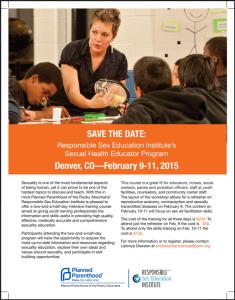
SAVE THE DATE: Responsible Sex Education Institute’s Sexual Health Educator Program

by co9to25
Real_Sex_Ed
Responsible Sex Education Institute’s
Sexual Health Educator Program
Denver, CO—February 9-11, 2015
Sexuality is one of the most fundamental aspects of being human, yet it can prove to be one of the hardest topics to discuss and teach. With this in mind Planned Parenthood of the Rocky Mountains’ Responsible Sex Education Institute is pleased to offer a two-and-a-half-day intensive training course aimed at giving youth serving professionals the information and skills useful in providing high quality, effective, medically accurate and comprehensive sexuality education.
Participants attending the two-and-a-half-day program will have the opportunity to acquire the most up-to-date information and resources regarding sexuality education, explore their own ideas and values around sexuality, and participate in skill building opportunities.
This course is a great fit for educators, nurses, social workers, parole and probation officers, staff at youth facilities, counselors, and community center staff.
The layout of the workshop allows for a refresher on reproductive anatomy, contraception and sexually transmitted diseases on February 9. The content on February 10-11 will focus on sex ed facilitation skills.
The cost of the training for all three days is $200. To attend just the refresher on Feb. 9 the cost is $50.
To attend only the skills training on Feb. 10-11 the cost is $150.
Responsible Sex Education
For more Information or to register, please contact Latonya Dawson at professional.training@pprm.org.
10th Dec2014

Boost your happiness with Science-Based Practices

by co9to25

The Science of Happiness

3 Good Things
Notice & Savor the best things in life by listing 3 things that went well today and explaining why they happened.

Mindful Breathing
Try to Focus only on the flow of your breath. Return your attention to it when your mind begins to wander. A simple way to gain peace of mind.

Gratitude Letter
Write a Letter Thanking an important person in your life. Deliver it in person. Read it out loud. Bring tissues.

Random Acts of Kindness
Do 5 Nice Things for someone else, all on the same day. Write down how it makes you feel.

Active Listening
Strengthen Your Relationships by becoming a better listener: ask questions, express empathy, and refrain from judging or giving advice.

For more information visit: greatergood.berkeley.edu/happinesscourse

10th Dec2014

Seven Double Standards That Hurt Young People

by co9to25


Double Standards Hurt Young People

To start important conversations about gender and double standards with your students, share this teen-written story, “Three Double Standards That Hurt Guys and Girls,” from Sexetc.org. For training on addressing the needs of transgender students in your classes, register for Answer’s online workshop LGBTQ Issues in Schools.

Pages:«123»