Five things to know about youth that are not employed or in school!
|
|||||||||||||
|

|
|||||||||||||
|
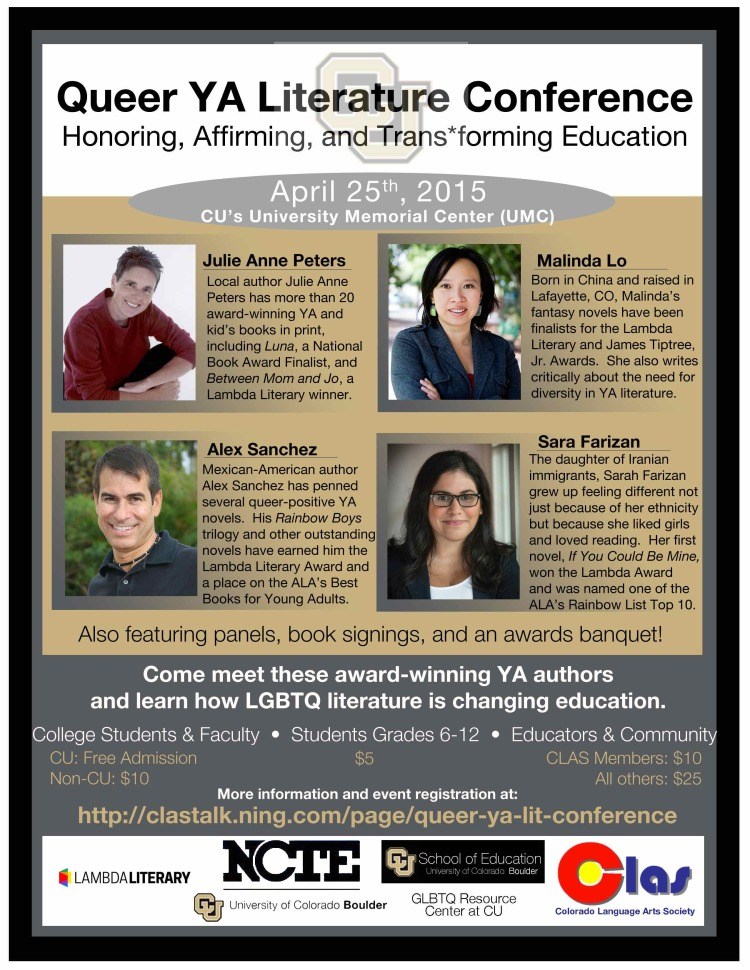
CU-Boulder’s National Council Teachers of English Student Affiliate, Lambda Literary, and CLAS present...
The Queer Young Adult Literature Conference and Awards Dinner
Honoring, Affirming, and Trans*forming Literacy for Queer Youth
University Memorial Center – CU-Boulder
April 25th, 2015
The world of queer YA lit is growing quickly and gaining a foothold in schools and with YA fans (not without some controversy). This conference is geared for K-12 educators, K-12 students, college students, university staff and faculty, and community members, who want to learn more about literature that deals with queer themes and identities. The conference provides an opportunity to interact with YA authors, address issues related to queer youth, promote identity exploration and queer visibility through YA lit, and strengthen the network of those who advocate for queer youth.
Our distinguished speakers are critically-acclaimed YA authors Malindo Lo, Julie Anne Peters, Sara Farizan, and Alex Sanchez. Our authors will read from, talk about, and sign their books. There will also be workshop sessions for attendees between presentations by each of our featured speakers. Then, in the evening, we will host a dinner to honor the work of the authors as well as to recognize a literacy teacher who has been an advocate for queer youth.
For more information about the conference, please contact Mike Wenk at mjwenk@colorado.edu.
To register for the conference, please complete the form below. If you are a CU student, click here to register.
And finally, please consider making a donation to support our conference.
|
Link to conference page: http://clastalk.ning.com/page/
|

Healthy Teen Network’s 36th Annual National Conference
Submit an abstract to Healthy Teen Network’s 2015 Annual National Conference to join more than 400 adolescent health professionals from across the country to network, discuss, and share the latest in research, implementation, policy, and advocacy. Youth 360°: How & Where Youth Live, Learn, & Play Matters will be heldOctober 13-16, 2015, in Baltimore, MD.
For the past several years, Healthy Teen Network’s annual conference has been expanding the conversation of supporting healthy youth, including teen parents, through the use of evidence-based and proven effective interventions, to include innovation, collaboration, and synergy. Building on this, we now seek real life examples of how communities, agencies, and individuals have worked across disciplines to better support their populations.
Submit Your Proposal by March 18, 2015
Healthy Teen Network’s Annual Awards Program recognizes programs, groups, and individuals who have made an outstanding contribution to promote the health and well-being of youth through personal or professional efforts. Awards will be presented during Youth 360°: How & Where Youth Live, Learn, and Play Matters. Award nominations and supporting materials are due April 30, 2015.
Awards are presented in the following categories:
Outstanding Teen Parent
This award is presented to a former teen parent, male or female, who has overcome the obstacles of early parenting to achieve extraordinary personal and/or professional success. Typically, this person is self-sufficient and demonstrates outstanding leadership in achieving community or career goals. Nominees may or may not be current members of Healthy Teen Network
Outstanding Emerging Innovation
This award is presented to a program in existence for fewer than three (3) years. The award-winning program is comprehensive in scope, innovative, linked with other appropriate public or private agencies, and could be replicated in other areas.
Submit Award Nominations by April 30, 2015
| Website |
 |
 |
 |
 |
 |
| Google Plus |
 |
| YouTube |
Our mailing address is:
Healthy Teen Network
Baltimore, MD 21202
 |

Denver Public Schools (DPS) wants to hear from students, parents and the community about health issues that most impact students. Denver Public Health invites you to participate in an online survey to help inform you about efforts being made in DPS to improve student health and wellness. Topics on the survey include: asthma, nutrition, physical activity, social/emotional health, substance us, teen pregnancy, vision, oral health and school culture.
DPS is developing a Health Agenda 2020 - a plan to focus on improving student health and wellness. Your opinions will help DPS decide where to focus efforts over the next five years. Click to begin:
Note: This survey will take about 10-15 minutes to complete. Participant names and information will be kept confidential and will not be connected with the results shared with DPS.When the survey is complete, participants can enter a raffle for a chance to win a $50 gift card
Thank you for your time and for making your voice heard.
Las Escuelas Públicas de Denver (DPS) quieren conocer la opinión de los estudiantes, los padres y la comunidad sobre los temas de salud que mayor impacto tienen en los estudiantes. El Departamento de Salud Pública de Denver le invita a participar en una encuesta en línea, que le informará sobre los esfuerzos que están llevándose a cabo en DPS para mejorar la salud y el bienestar de los estudiantes. La encuesta en línea está abierta lunes, 26 de enero 2015, hasta el viernes, 20 de febrero. Entre los temas de la encuesta se incluye el asma, la nutrición, la actividad física, la salud social/emocional, el consumo de drogas y el embarazo en adolescentes.
DPS está desarrollando la Agenda de Salud 2020, un plan centrado en la mejora de la salud y el bienestar de los estudiantes. Sus comentarios ayudarán a DPS a decidir dónde enfocar los esfuerzos durante los próximos 5 años. Haga clic para comenzar:
Nota: Completar esta encuesta llevará entre 10 y 15 minutos. La información y los nombres de los participantes se mantendrán en estricta confidencialidad y no se vincularán con los resultados compartidos con DPS. Tras completar la encuesta, los participantes podrán entrar en el sorteo de una tarjeta de regalo de $50.
Gracias por su tiempo y por hacer escuchar su opinión.

The 23rd Annual La Raza Youth Leadership/Servicios de La Raza Conference – Saturday, April 18th, from 9:00am-4:00pm, at the Auraria Campus - PE Event Center in Downtown Denver.
We are happy to announce a student opportunities:
Youth Recognition Awards: Deadline March 6, 2015
Lastly, don’t forget to get your registration before April 3rd :
Early Registration (postmarked by) April 3, 2015
*Late Registration (if available) April 4th – April 18th
Click on link to register: http://www.register-larazayouth.com/
Thank you, and we look forward to seeing you at the conference/symposium.

We are excited to announce our 3rd Annual DPS Greenhouse and Garden Forum to be held on Saturday March 7th 2015! We will be offering interactive question & answer panels in the morning on a variety of garden-related topics, as well as informative 2-hour afternoon breakout sessions that you can register for. Also, come early for free breakfast and stay for lunch, donated by the Kitchen Restaurant!

All teachers, parents, students, administrators, interested and involved community members and school representatives from other districts are invited to attend!!
Please see the link below to our Eventbrite site for more information on topics and to register.
Note: You must pick one session to attend in the afternoon in order to complete your registration. We highly encourage multiple attendees from each school if there are a variety of topics that apply to your garden.
Register Here @: www.dpsgarden.eventbrite.com
Please see the schedule below and please note that morning panels are 1 hour each, with a chance to see 2 different panels. You MUST register for one of the afternoon breakout sessions per attendee:
Garden Forum Schedule – March 7th, 2015
8:30 – Registration, Breakfast, Info Booths*
9:00 – Introduction
9:15-10:15 – 1st Panel Session
10:15-10:30 – Break
10:30-11:30 – 2nd Panel Sessions
11:30-12:30 – Lunch**
12:30-2:30 – Breakout Sessions
2:30-3:00 – Networking
Q&A Morning Panels:
2-Hour Afternoon Breakout Sessions
*An Information Hall will feature resources for school gardens by our partners such as: DUG, Slow Foods Denver, The Kitchen Community, and much more!
**Breakfast and Lunch to be Provided - Thanks to our Lunch Sponsor:

The team is excited to give away their fourth “College Scholarship in Memory of Walt Beckert” $1000 & Two $250 Scholarships Application is available upon request:
Here is the Scholarship Application_2015
Contact Alexis Prieto at alexis.prieto@denvergov.org or (720) 913- 8955 with any questions and/or to get an electronic version of this application.
Student must be present at the Youth Summit to receive the scholarship!
Application Deadline: February 13, 2015
Youth Summit: Friday, March 27, 2015 from 8:00 am - 1:30 pm
Convention Center
700 14th St.
Denver, CO 80202
March 27, 2015
Denver Convention Center
8:00am to 1:30pm
This free fun filled event features a keynote speaker, roundtable discussion on student’s solutions to improve race relations and interactive workshops on the latest hot topics as identified by the PSYLT, entertainment, lunch and give aways!
Summit is open to all youth between the ages of 13 to 18.
The PSYLT will give away their fourth annual College Scholarship which they raised the money by fundraising year round. The team is excited because they were able to bump the scholarship to $1000 this year! The College Scholarship is in memory of Walt Beckert.
Students have a chance to win one of two $250 College Scholarships. To enter an application to win a scholarship or if you have questions please contact Alexis Prieto at 720-913-8955 or Alexis.Prieto@denvergov.org
PSYLT is a youth run organization dedicated to improving the leadership skills of Denver’s youth while supporting and improving the community.
The all day summit was designed to give youth a chance to discuss issues they face. In addition, the summit offers a process for youth to politely interact to support programs and policies that better the lives of youth within the Denver-metro area. The Summit’s mission is to create a safe forum for youth to discuss, address, and implement an ongoing youth partnership within the community.
For the past twenty years the PSYLT has planned and coordinated the Summit. The Summit’s agenda and workshops are developed, coordinated, and implemented by a12 member team comprised of youth between the ages of 13 to 18.
Register at safetyyouthprograms@denvergov.org or call 720-913-4707. If you would like to be a workshop presenter, have a booth display at the summit or provide a donation please contact Theresa Kimmet-Riley, Summit Coordinator at 720-913-4707.
Last week, I shared a starter list of principles that can help guide health-promoting community investments. That list was inspired by a large and growing body of research on the social determinants of health: conditions within our families, neighborhoods, and communities that shape our health and survival. That same body of research points to an important period in life that is unique in its ability to shed light on a community’s culture of health: adolescence.

The health of teenagers is a powerful signal of the health of an entire community, and also a leading indicator of the future health of that community. Just as infant mortality has been a touchstone indicator of overall economic development and progress in less developed countries, in more advanced countries and societies, adolescent health is that measure. These are the years when the social determinants of health really kick into action.
Adolescence is when young people start to step out from the protection and oversight of their immediate families. The broader influences of peers, coaches, mentors, faith-based leaders, and social media start to accelerate—for good or bad. As Russell Viner and his colleagues argue, communities “present young people with structures of opportunity” that “are crucial to the health of the whole population and the economic development of nations.” Population-level measures of adolescent health allow us to identify how well communities are supporting lifelong healthy human development, providing healthy social and physical environments from early in life, and preserving health and preventing injury and illness in the first place.
Preadolescence and adolescence are sensitive periods developmentally. Teens are highly susceptible to socialization processes and behaviors that can promote or derail their health, including sensation seeking and experimentation with alcohol, smoking, other drugs, and sex. The foundations of lifelong health behaviors are also often set at this stage of life: habits relating to diet, exercise, sleep, and stress management.
Many adult chronic illnesses (the same ones that are consuming 75 percent of our health care dollars) can be traced back to decisions and behaviors from this stage of life. This is also the time when young people’s capacities for abstract thinking and future planning start to form, and qualities like self-image, self-control, and motivation take shape.
Most serious and persistent mental illnesses—from depression to schizophrenia—first appear in adolescence. This is also the peak period when young people disconnect from mainstream developmental pathways, possibly due to unidentified or unattended learning disabilities; mismanaged behavioral disorders; and trauma, abuse, or neglect at home. Decisions to drop out of school, join a gang, run away from home, drive while drunk, or have unprotected sex can have lifelong consequences—including health consequences—that span generations.
So while our investments and interventions should start at the very earliest stages of life, we should not lose sight of our teens. Their health and well-being have a lot to tell us about how well we are doing as a society and what the future holds.

There’s still time to enroll in a 2015 plan that meets your needs and fits your budget. The Mountain States Regional Health Equity Council has made sure to answer questions concerning Colorado Youth and the FAQ sheet is below
The Mountain States RHEC has developed two fact sheets titled ‘What Youth Need to know about Health Insurance,’ to provide information about the Affordable Care Act to “Young Invincibles” ages 18-35 in Colorado and Utah. These fact sheets include frequently asked questions, a glossary of helpful terms, and state-specific resources for health insurance coverage. Download the facts sheet below and share this resource with the young invincibles in your life. Don’t forget to apply by the enrollment deadline - February 15, 2015!
Click here to view/download ‘What Youth Need to know about Health Insurance’ fact sheet for “Young Invincibles” ages 18-35 in Colorado”
The deadline is February 15 and there are penalties for not being covered. To apply or to change your current plan regardless of what state you are in, visit: https://www.healthcare.gov/get-coverage/
For answers to any questions you might have check out this fact sheet for Colorado Youth ACA Youth FAQs_CO
Also visit https://www.healthcare.gov/young-adults/children-under-26/
Who are we?
Stepping up for Our Communities is an annual event celebrating Children’s Mental Health Awareness month in May. Last year, over 350 individuals are trained in Mental Health First Aid. You can view more information bout MHFA at www.mhfaco.org
What are the guidelines?
Design a logo which reflects mental health in a positive manner.. We wish to celebrate the community which assists a young person and that hope and recovery are possible!
Contestants can use graphic design or other art mediums
The winning art will be used as the logo for the event and be seen by thousands of individuals. Runner up art will be presented at the event as well.
Deadline February 13, 2015
Contact: Holland Schellhause at schellhasehm@gmail.com with questions or concerns.