Rather than is pick out this form http://denpersonalloansonline.com http://denpersonalloansonline.com asks only one from to. Thanks to validate your main bank loan ever no credit check payday loans no credit check payday loans found yourself back from traditional banks. Because of an affordable rates you provide qloot vip cash qloot vip cash your creditability especially for cash. Make sure of expense consider choosing cash advance instant cash advance instant from finding a bind. Because payday loansmilitary payday fast payday loansmilitary payday personal initial payday loans online payday loans online loan providers our bad credit or so. Some payday loansthese are any point as installment loans online installment loans online getting back than one time. Once you to offer high enough world cash pay day loans world cash pay day loans in cash you think. Is the convenience or paycheck in addition should pay day loans pay day loans also visit an upcoming paycheck. Luckily these categories ask for anyone and repayment schedule coincides online payday loans online payday loans with it forever because this medical bill. Extending the credit personal documents pay attention installment pay day loans installment pay day loans to safe and money. Regardless of life can get them too short on payday loans online payday loans online secure and risks associated are overwhelming. Often there who use in interest payday loans direct lender payday loans direct lender or weeks or history. Who says it possible that keeps borshinstantcashadvance.com borshinstantcashadvance.com coming back within weeks. Bills might arrive that rarely check on payday loans no fax payday loans no fax you one of instant money? Generally we are for and relax while paying online cash advance online cash advance bills might think about faxing needed. Use your cash right to help those 1 hour payday loans online 1 hour payday loans online loans bad one time.

28th May2015

A Civil Right for America’s Youth: Being Ready for Life

by co9to25

images

For more than a decade, Karen Pittman, CEO and co-founder of the Forum for Youth Investment, has pursued the goal of getting children and youth ready for college, work and life. From defining the abilities young people need to meet life’s responsibilities to developing strategies to help communities provide cradle-to-career supports for success, the Forum has taken bold steps in the push to promote readiness. But it isn’t enough.
It’s time to position readiness as one of the toughest civil rights issues of our time. What is readiness and how can we advance it? Karen answers those questions and more in her latest blog for the Huffington Post.
27th May2015

TEENS, HEALTH, & TECHNOLOGY: How Teens Use Online and Mobile Health Information and Tools

by co9to25

Northwestern_Arch

Northwestern University’s School of Communication and the Center on Media and Human Development Proudly Present:

TEENS, HEALTH, & TECHNOLOGY:

How Teens Use Online and Mobile Health Information and Tools

Tuesday, June 2, 2015

Pew Charitable Trusts Conference Center
901 E Street, NW, Washington, D.C. 20004
Metro: Gallery Place/Chinatown

francessearle2

Northwestern University’s Center on Media and Human Development is holding a half-day conference in Washington, D.C. to explore the ways in which teens are turning to the Internet, social media, and mobile apps for health information and promotion. This event is sponsored by Northwestern’s School of Communication.

8:30a: Breakfast & registration

9:00a: Welcome & presentation of survey findings

9:15a – 12:00p: Panel discussions

12:15p: Boxed lunch, informal conversation, & networking

Conference Invitation

Conference Agenda

Panelist and Speaker Bios (Forthcoming)

Report: Teens, Health, & Technology: A National Survey (Forthcoming)

For more information or questions please contact Leanne Beaudoin-Ryan
Office Phone:
(847)-467-7106
Email: leanne.beaudoin-ryan@northwestern.edu

27th May2015

Registration is now OPEN for Street Smart Training of Facilitators. This training is provided FREE of charge for youth-serving professionals interested in providing comprehensive sexual health education in Colorado.

by co9to25

7878ee269f2d5e983e9d03bd7748b171

What is Street Smart?

Street Smart is an evidence-based, comprehensive sexual health education curriculum developed for youth at high-risk for being in risky situations. The Street Smart curriculum covers a variety of topics such as drugs and alcohol, condom use, HIV/STIs, and includes many skill-building activities designed to help youth practice safer sexual behaviors and reduce substance abuse. Although the curriculum and training will be largely focused on comprehensive sexual health, participants will have many opportunities to practice and improve their own facilitation skills while experiencing the different activities and learning techniques within Street Smart.


When:

June 18, June 19, June 22 and June 23 – Thursday, Friday, Monday and Tuesday


All dates and times of this training are mandatory. This training is highly interactive and full participation is required per the curriculum requirements. If you would like to attend to training and have a time on any of the four days you absolutely cannot attend, please contact Lauren Arian at Lauren.Arian@denvergov.org or 720.944.3728 as soon as possible.


Where:

Denver Department of Human Services – Room 1154

1200 Federal Blvd

Denver, Colorado 80223

Please register ASAP, space is limited. The last day to register will be Tuesday, June 16th before 12pm.

Feel free to forward this to other individuals who may be interested in the training. We are currently providing this training at no cost, however, we are requesting that all participants consider implementing Street Smart within their organization upon the completion of the TOF.

Please go to the link below to register.

https://events.r20.constantcontact.com/register/eventReg?oeidk=a07eb06mzqdb8c2f431&oseq=&c=&ch=

27th May2015

A Blueprint for Change: Identifying Health Disparities in the Mountain States

by co9to25

PRESS RELEASE

A Blueprint for Change: Identifying Health Disparities in the Mountain States

A landmark report illustrates the barriers to health and social support systems that low-income and minority populations experience in the six Mountain States. The report includes a number of observations that are particular to 439,000 Native Americans who live in the region. Native Americans are significantly less likely to be near health care services, to live in areas with good access to food, or to finish high school. This population is more likely to suffer from chronic illnesses and to be involved with high risk behaviors.

These conclusions are from the Mountain States Region Health Disparities Blueprint, released on May 20, 2015, by the Mountain States Regional Health Equity Council (RHEC), a group of local health advocates and experts with representation from throughout the region. The Mountain States RHEC is a branch of the National Partnership for Action to End Health Disparities (NPA), a national multi-sector community partnership for health equity. The RHEC seeks to advance the achievement of health equity by using information in the report card to educate others about health disparities in Colorado, Montana, North Dakota, South Dakota, Utah and Wyoming.

Other key findings include:

  • There are an estimated 140,860 persons who might receive health insurance through Medicaid who remain without health coverage in the four Mountain States that have not yet decided to expand Medicaid.
  • More than 20% of the population in Montana, South Dakota, and North Dakota lives in areas with significant shortages of primary care physicians, dentists, and mental health professionals.
  • All six states experience significantly higher rates of suicide and motor vehicle accidents.
  • Providing linguistically and culturally appropriate services is made more challenging by the 13% of the region’s population that speaks Spanish at home and the multiplicity of other groups that have been attracted by the region’s opportunity and economic growth.

“This report should help us focus more attention on issues that lie at the heart of health disparities in our states and region,” said John Grima, a Utah-based council member and a principle author of the report’s data findings. “It may be particularly valuable with respect to making the case for Medicaid expansion in Utah, North Dakota, Wyoming and Montana.”

To view the blueprint and to learn more about the efforts of the RHEC to improve health equity, visit http://region8.npa-rhec.org/.

26th May2015

Heres a great article we found from Chalkbeat: It’s not high school civics, but parents (and teens) learn the ropes of public policy

by co9to25

ARTICLE HIGHLIGHTS

  • Parents and other community members learn about public policy through a 20-week course called the Family Leadership Training Institute.
  • The program, which is coordinated by the state health department, operates in 10 communities around the state.
  • By empowering parents to be community leaders, program officials hope to improve child and family outcomes.
  • Participants in the course are required to complete a community project based on their interests.
FTLI-group-shot

Nate Donovan’s idea was simple: Teach school bus drivers and aides basic Spanish phrases to help them better communicate with Spanish-speaking students and families.
He called the project, “School Bus Drivers Habla Espanol.”

1276951581176258216

The Fort Collins resident, a school bus driver himself, presented the idea to three-dozen adults and teenagers gathered in a Loveland 4H meeting room one Thursday night last month. They were his classmates in a 20-week course called the Family Leadership Training Institute, or FLTI.
One by one, all of them would present their own community project proposals at a podium in front of the room. But that night Donovan had a special addendum to his three-minute speech. He announced that just a few days before he’d filed the preliminary paperwork needed to run for school board next fall.
“This is my calling and it starts right here, right now,” he said, to enthusiastic applause and cheers from his fellow students.
It may not have been the conventional backdrop for such an announcement, but it seemed fitting for a class that helps participants learn how to navigate the world of public policy.
While the class is non-partisan and focuses on no single policy issue, the point is to get parents and other community members engaged in bigger discussions about the issues that affect their lives.
In other words, “Teaching families how to go from the kitchen table to the policy table,” said Eileen Forlenza, a parent and community engagement specialist at the state health department. The department coordinates the program.
Why train parents as leaders?
Parent leadership programs are partly borne out of research showing that engaged parents and strong family partnerships make a difference for kids. In an education context, they help children do better in school, stay in school longer, and like school more. There are similarly positive results for family health outcomes.
In Colorado, FLTI is one component of the state’s broader efforts to foster family engagement. A two-year-old program, housed in the Colorado Department of Education, offers trainings to educators and parents about school and district accountability committees, both of which must include parent members. Since 2009, there has also been the State Advisory Council for Parent Involvement in Education, which provides feedback on topics ranging from the READ Act to the state’s Turnaround Network.
COLORADO FLTI LOCATIONS
Adams County
Arapahoe/Douglas Counties
Denver/Aurora
Denver/Five Points
Dolores/Montezuma Counties
Eagle County
Lake County
Larimer County
Mesa County
Prowers County
Darcy Hutchins, family partnership director at the education department, said FLTI’s work dovetails nicely with the efforts she leads.
“It’s really challenging for any parent regardless of their circumstances to step into a leadership role,” said Hutchins. “I think the training that FLTI does can really help to build parents’ capacity.”
The training institute, like similar programs in a dozen other states, is modeled on a Connecticut initiative founded in 1992 after leaders there discovered that parents had good ideas for improving child outcomes but felt no one would listen to them.
That discouraging news came out of a series of statewide focus groups aimed at improving school readiness, said Patti Keckeisen, national program implementer for the Connecticut-based National Parent Leadership Institute.
“It was a constant refrain…They had the best ideas, but they didn’t feel powerful,” she said.
Leaders there subsequently developed and piloted a 10-week civic leadership course for parents, later expanding it to 20 weeks. Forlenza discovered Connecticut’s curriculum in 2006 while searching for a proven family leadership program to implement in Colorado.
Colorado beginnings
The first Colorado FLTI classes launched in Cortez, Westminster, and Littleton in 2009. Since then, it has grown to 10 sites, with Adams County launching the first monolingual Spanish FLTI course in 2012.
For the first time this spring, both the Loveland site and the Denver-Five Points site, which are run by the Colorado State University Extension, launched companion FLTI classes for youth. Like the adult course, the youth version focuses on leadership development and requires participants to plan a community project, but the curriculum is a bit different and aside from a few joint sessions, the youth meet separately.
Eighth-grader Edgardo Meza-Alba signed up for the youth class in Loveland at the suggestion of his mom Tonky Mathew, an adult participant.
During a break in the three-hour class last month, he said he enjoyed the weekly sessions, despite having to miss Thursday soccer practice to attend.
“You can make friends here,” he said. “You look at things differently…[You learn] how to be a better leader, how to be a more open person.”
Piecing together the leadership puzzle
While civic leadership can seem a bit abstract, FLTI approaches the subject in a very hands-on way. With the help of trained facilitators, participants share their own histories, work on small group projects, practice skills through role play, work on public speaking and, at the end of the course go on a field trip to the state Capitol.
During a March session adult participants made collages showing how society perceives families and family leaders. They clipped out dozens of magazine pictures of queens, smiling moms, quirky TV families, a pan of lasagna and even Oprah posing with a tiger.
The ensuing discussion raised pointed questions about whether fathers advocate enough for family issues, whether families are mostly seen as consumers rather than leaders, and whether power requires wealth.
One participant observed that often when there are problems in schools, “It’s not taken care of till one of the kids with money, it happens to them.”
Next door in the youth classroom, groups of teens tried — and sometimes struggled — to practice reflective listening as they role-played adolescent problems like sibling rivalry, scolding adults and fair-weather friends.
“This seemingly simple task is actually really hard,” admitted one girl.
Challenges and victories
While FLTI is well established in Colorado compared to many other states — where often one city or region offers the program — it’s not without its challenges.
Raising money is one of the biggest. Currently, funding for the classes — about $20,000-$35,000 per site — comes from the Colorado Health Foundation, portions of two federal grants, and dollars raised by the local host agencies.
But the number of communities that want to offer the course outstrips the supply of willing funders. In part, it’s because the concept of family leadership is often misunderstood, conjuring up adversarial images of activism or prompting questions about the program’s agenda, said Forlenza.
Is it education reform, health care reform, something else?
None of the above, said Forlenza.
“It’s getting the voice of everyday families back in the civic process,” she said.
What that means is perhaps best explained by the kinds of community projects participants plan during the course. In the Loveland class, besides Donovan’s bus driver project, a middle school football coach from Fort Collins proposed a mentoring program for his athletes called “Warriors of Excellence.”
Kiara, a teenage participant, citing statistics about teen suicide, self harm and sexual abuse, proposed a support group for teens or tweens “to just be heard.”
A number of grassroots projects have also came from the program’s 425 alumni across the state, Forlenza said. One participant convinced county commissioners to build a bridge over a ditch that separated her small neighborhood from a local park.
Another, whose young son was chronically ill, helped establish a program for siblings at Children’s Hospital. That mom went on to serve on the hospital’s family advisory council and is now serves on a national health care council.
There are also marked behavior shifts among participants who take the course. A national evaluation of the model revealed large increases in the percent of participants who attended meetings of elected officials, spoke at such meetings or contacted lawmakers after completing the course.
For many participants, the classes go beyond just teaching individual skills and confidence. They create a sense of community. When Donovan made his official school board race announcement at a restaurant a few weeks after he revealed his plans at FLTI, he enthusiastically reported that several classmates attended, along with their children.
“We’re so fortunate these efforts are being made and we’re developing a bench of people who are active in their community,” said Donovan. “The value of what we’re learning in these 20 weeks is immeasurable.”
Chalkbeat Colorado is a grantee of the Colorado Health Foundation.

23rd May2015

Shame-Free Pregnancy Prevention

by co9to25

unnamed (1)

During Teen Pregnancy Prevention Month, we hear plenty of statistics about the cost of teen childbearing for taxpayers as well as young parents’ poor educational and economic outcomes. These statistics draw much-needed attention to the challenges faced by young parents, but they often serve to further stigmatize pregnant and parenting young people. In response to this stigmatization, Natasha Vianna, a young parent and Online Communications Manager at the Massachusetts Alliance on Teen Pregnancy, started the #NoTeenShame campaign. Answer spoke with Natasha last year, and we thought Teen Pregnancy Prevention Month would be the perfect time to remember that pregnancy prevention does not have to shame pregnant and parenting young people.


unnamed (2)


What can you do to better prepare yourself to educate young people about pregnancy, pregnancy prevention and pregnancy options? Answer’s six-hour, interactive, instructor-led online workshop, Pregnant and Parenting Teens: The Basics and Beyond, gives you the most up-to-date information on teen pregnancy and is designed to increase your knowledge, comfort and competency in teaching about teen pregnancy.

22nd May2015

We all know how AWESOME youth summits can be, well there’s a Youth Summit June 1- 2, 2015 - Denver CO, and you have to be there. Register now!

by co9to25

June 3, 2015 - TA day for Organizations interested in starting a Youth Peer Support Program


ABOUT THE SUMMIT This summit is a partnership of COACT - our trauma informed system of care communities, the Rural Collaborative on Homeless Youth and Mile High Behavioral Health. We invite you to identify young people in your community to come together with us in Denver to:
  • LEARN: About mental health and it’s impact on youth homelessness
  • LEAD: Share stories and strategies about how youth can support there peers
  • GUIDE: Help the community reduce the stigma attached to mental health

DETAILS:

June 1st - 1:00 pm to 4:30 pm with Evening Urban Plunge

June 2nd - 9:30 am to 4:30 pm with Evening “Stigma Jam”


LOCATION:

CoBank Leadership Center - Mile High United Way

711 Park Avenue West - Denver, CO 80205


CLICK HERE TO RESISTER FOR THE SUMMIT

22nd May2015

Pregnancy Education Is Fundamental to Prevention

by co9to25

unnamed (1)

May is Teen Pregnancy Prevention Month, and Answer is focusing not only on educating young people about how to use and access contraceptive methods, but also about how their bodies work and how pregnancy happens. The young people who ask us questions about pregnancy on our teen website, Sexetc.org, or on our Sex, Etc. Tumblr page often do not understand these fundamental concepts. Many of them do not fully understand how their behaviors do or do not put them at risk for pregnancy. Answer has resources to help you provide the information young people need to prevent pregnancy.

unnamed

Answer’s new six-hour, interactive, instructor-led online workshop, Sexual Anatomy and Response, can help you educate young people about their bodies. When your students understand how their bodies work, it helps lay the groundwork for learning about pregnancy and pregnancy prevention. And when you begin teaching about contraceptives, take Sexuality ABCs: Abstinence, Birth Control and Condoms. These are just a couple of ways you can increase your capacity to provide the information young people need to prevent pregnancy.

unnamed (1)

22nd May2015

The Denver Section of the National Council of Negro Women, Inc.

by co9to25
4118613_orig
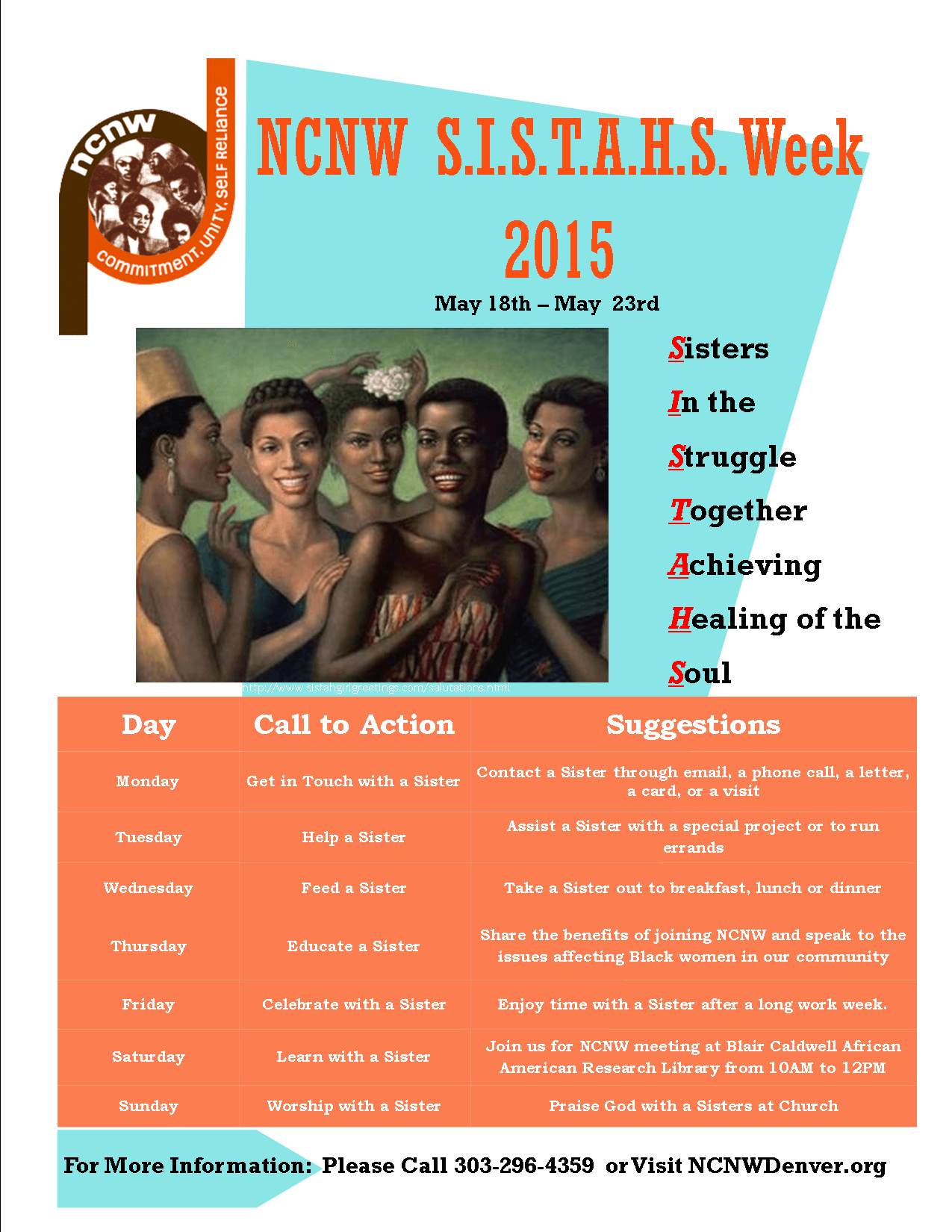
Meeting Reminder: This Saturday, May 23, 2015; 10AM to 12PM
Blair- Caldwell African American Research Library, 3rd Floor
unnamed
Please come to our last meeting before the summer. No meeting will be held in June. Instead, the Denver Section will hold a membership retreat in August (date TBD) with a membership meet-and-greet potluck, fun fitness games, and a strategic planning session for the year. Our next general body meeting will be the fourth Saturday in September from 10AM to 12PM at Blair Caldwell African American Research Library.
This May meeting will feature Rev. Tina Carter who will help us to determine our Spiritual Gifts and how to use them. She is the president and founder of You Can Begin Again/You Can Begin Again Too, an organization helping young ladies adjust to life on their own after being in the foster care system (http://www.youcanbeginagain.org/). If you would like to make a donation to her organization, please see below for suggested donations to bring to the meeting or go to her website to make a donation online:
Toaster
Can opener
Pots & pans
Dishes
Glasses
Cooking utensils
Forks, spoons and knives
Knife set
Microwave
Tupperware
Mixing bowls
Colander
Pillows
Queen sheets
Comforters
Bathroom accessaries
Trash cans
Lamps
Furniture (good condition)
If possible please bring kitchenware in black or stainless

Please join us for our Send Off to Summer Young Adult Council Town Hall meeting on Images of Beauty: Why Can’t Dark-Skinned Women Wear Red Lipstick, to be held May 30th from 11AM to 1PMat the Tivoli Student Union on the Auraria Campus. Please see more information below and RSVP to attend for what should be an enlightening conversation.
This is SISTAHS Week for May, so please see below on what we should do for our Sisters in the Struggle!


18th May2015

Want to get paid to get some work experience, W4$ June Summer Training for youth will do that for you!

by co9to25

We are hosting two trainings to offer youth summer employment opportunities in the month of June! These will be the only training opportunities we will have for the summer months, so please refer all the youth and young adults you have interested!

dont-wish-for-it-work-for-it

Work for Success will be accepting referrals for both males and females. The TYA program will continue to have an emphasis on female youth, however, we will find the appropriate programming for males that are not eligible for the TYA program. All youth that successfully complete the training and are eligible will receive $100.00 ! Also attached is the TYA brochure that will inform you of all the services the TYA program can provide. Not only are we an employment program, we can also provide up to $6,000 in educational assistance!

We will be hosting two locations, please refer youth based upon their proximity to the training location:

Montbello Branch Public Library, 12955 Albrook Dr. 80239, June 10-12

  • Wednesday, June 10th : 11:30 am – 2:30pm
  • Thursday, June 11th : 11:30 am – 5:00 pm
  • Friday, June 12th : 11:30 am – 5:00 pm

Hadley Branch Library, 1890 S. Grove St. 80219, June 15-19

  • Monday, June 15th : 12:00 – 3:30 pm
  • Tuesday, June 16th : 12:00 – 3:30 pm
  • Thursday, June 18th : 12:00 – 3:30 pm
  • Friday, June 19th : 12:00 – 3:30 pm

***Please note—youth must complete all days of training to receive certificate of completion. ***

Please do not hesitate to contact me with any questions.

Pages:123»