People often have different degrees of intimacy with the people in their life.
The relationships we have with others are very powerful-they can influence our decisions, our behaviors, and ultimately, our health and well-being.
Elements, or social determinants of health, to consider in the relationships youth have with others may include
- Positive role models
- Emotional support
- Supervision & monitoring
- Positive social networks
- Healthy relationships
- Peer support
- Warm & open communications
- Education & employment of caregivers
As professionals we need to think about the people who comprise a young person’s primary social network, such as parents and caregivers; family and siblings; friends; peers; romantic partners; co-workers; professionals and other adults in their life; children, for pregnant and parenting teens. We also need to think about the degree of intimacy for that relationships. Is the relationship very intimate, somewhat? Is there dependency for food or shelter, for example?
Young people are managing many relationships at once. As youth-serving professionals, it’s important to ask, how or where did they learn their relationship skills? Because we learn these relationship skills from the very people with whom we have the relationships-our parents and caregivers, family, friends, peers, romantic partners, co-workers, etc.
Furthermore, how do these conditions (i.e., the different level of intimacy and nature of relationships, as well as the places/individuals from whom they learn their relationship skills) impact the health of young people’s relationships.
We know what healthy relationships look like…
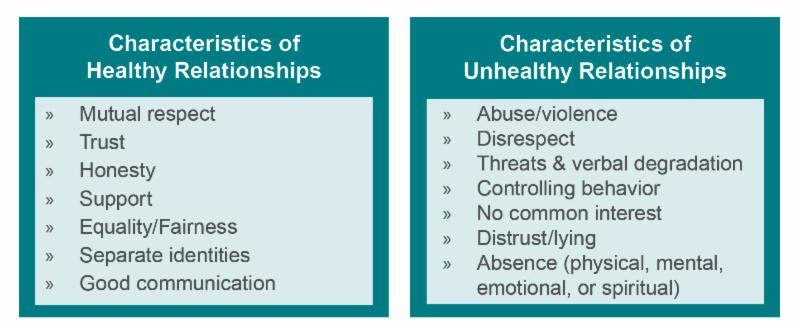
Given the context of how youth form relationships and learn relationship skills, how can we (as professionals) support their likelihood of engaging in healthy relationships?
And in the case of pregnant and parenting teens, how much more complex are their relationships? And how can we support them to engage in healthy relationships, not just with their family, friends, current and former partners, and children, but also the network of professionals who work with them?
Contact Healthy Teen Network today to learn how we can support your capacity-building efforts to support youth in forming healthy relationships with their families and friends, as well as professionals.
For example, one training we offer is
Healthy Relationships and the Impact of Trauma
In order to support pregnant and parenting teens, professionals need to be able to engage youth in ways that motivate them to heal unresolved pain and maintain healthy relationships. To do so, we need to understand the role Trauma plays on the shape/type of relationship youth hold. A way to do this is using Trauma Informed Approaches (TIA), which helps us identify trauma’s effects on sexual decision making as well as identify different techniques for addressing youth’s needs.
Or, you can sign up today for our next webinar,
Hearing the Child Within: Trauma Informed Approaches, on February 18 at 3pm ET, with presenters Pat Paluzzi, CNM, DrPH, and Deborah Chilcoat, MEd.